
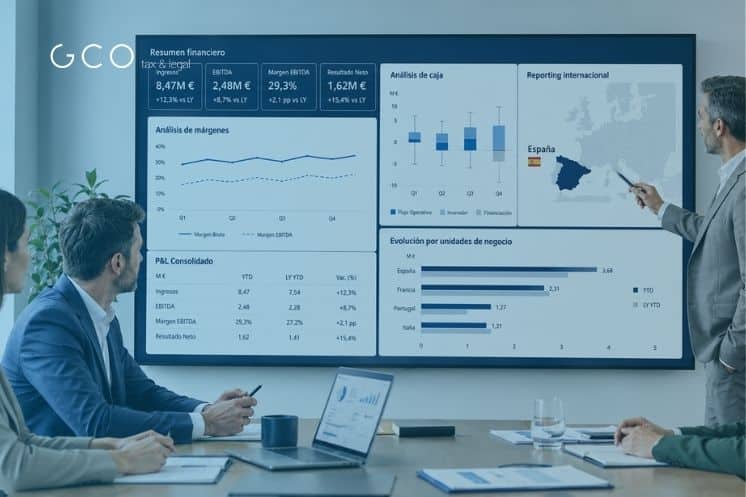
If your group operates in Spain through a subsidiary, branch or investee company, you already know the real challenge is not just complying with local regulations. The real challenge is having clear visibility into what is actually happening in the business and turning that information into fast, reliable decisions aligned with head office.
Because when financial control breaks down, the issue is not just a delayed close. It also leads to questions around margins, friction in group reporting, limited visibility over cash, and the uncomfortable feeling that decisions are being made without the full picture.
In this article, you will see what a strong financial control system in Spain should include, which mistakes European groups often make when managing local reporting, and how to gain structure, comparability and confidence without making operations more complex.

Setting up in Spain is a strategic decision. Managing it properly is too.
Many European groups enter Spain with a clear plan to sell, hire and grow.
What is not always properly resolved from the outset is how the subsidiary’s financial information will be controlled and how it will be turned into useful reporting for the group.
And that is where the problems begin.
Local accounting follows its own course. Headquarters asks for a different format. The close is delayed. Treasury, provisions, depreciation or payroll costs are reviewed in a rush. And when the time comes to explain a variance, the team spends more time rebuilding the numbers than interpreting them.
At that point, financial control stops being an administrative function.
It becomes a management tool.
What financial control is and why it matters so much in a Spanish subsidiary
Financial control is the system that allows you to understand what is really happening in the company from a financial, accounting and operational perspective.
It is not just about recording transactions or filing statutory accounts.
It is about answering questions like these clearly:
- Are we making money in Spain, or just increasing revenue?
- Which areas are deviating from budget?
- How much real cash will we have in 30, 60 and 90 days?
- Are local reporting and group reporting telling the same story?
- Are we meeting our financial, tax and corporate obligations without creating unnecessary risk?
In European groups, financial control also has a critical role: translating the reality of the Spanish business into the language head office needs in order to make sound decisions.
The real challenge: complying in Spain while reporting to the group at the same time
Local compliance does not always mean good reporting.
In fact, a company can have up-to-date accounting and still generate friction every month in its reporting process.
Why?
Because the local close follows an accounting and legal logic. But headquarters needs comparability, speed, context and decision-focused information.
So the challenge is not only accounting-related. It is structural.
You need a model that brings together three things:
- Reliable accounting information. The foundation needs to be sound. Financial statements remain the starting point for understanding the company’s financial position and performance, assessing liquidity, profitability, solvency and overall business evolution.
- Indicators that support interpretation. Management does not just need numbers. It needs signals. Financial KPIs do exactly that: they measure performance, detect issues before they turn into bigger problems, and support decision-making with a clearer business view.
- Reporting that connects with head office. The information must be clear, consistent and useful for a group comparing countries, subsidiaries and business units.
What usually goes wrong in the financial control of a Spanish subsidiary
Some issues appear again and again.
1. The local accounting close does not match the group reporting requirements
The subsidiary works with its own accounting criteria, calendar and level of detail.
Head office needs a different structure, a different cut-off and a different format.
The result: the team rebuilds the information every month.
2. Financial data arrives too late
When the close takes too long, the management committee ends up making decisions based on outdated information.
And even correct figures lose value when they arrive late.
3. Lack of coordination across functions
Financial control does not depend on accounting alone.
It also depends on how payroll, contracts, tax, provisions, inventories, depreciation, billing, collections and payments are coordinated.
If each area works in isolation, the reporting will be incomplete.
4. There are too many manual adjustments
When the model depends on parallel Excel files, last-minute reviews and multiple versions, data quality deteriorates.
5. The number is reported, but not the story behind it
Head office receives the result.
But it does not always understand what is driving it.
And without context, the data loses usefulness.
A clear cost accounting model helps add that context. It shows which products, clients, projects or business lines are generating real margin, which ones are consuming resources, and where the variance is actually coming from.
What a good financial control system in Spain should include
A strong financial control model does not have to be complex.
It has to be useful.
These are the elements that should not be missing.
A clear closing calendar
The close cannot depend on urgency.
There must be a defined timetable with responsibilities, deadlines and review steps covering invoicing, reconciliations, provisions, payroll costs, depreciation, inventories, intercompany transactions and final review.
The more stable the process, the less friction reporting will generate.
A mapping between local accounts and group reporting
This point is key.
If there is no clear bridge between local accounting and the structure used by headquarters, the team will lose time every month reinterpreting the figures.
A proper mapping reduces errors and avoids rework.
Review and control rules
Good financial control includes reviews of:
- Revenue and its correct accrual.
- Material expenses.
- Receivables and payables.
- Intercompany balances.
- Treasury.
- Budget variances.
- Margins by business line or unit.
- Accounting or documentary issues.
This is not about looking more.
It is about looking better.
KPIs that support decision-making
You do not need twenty dashboards.
You need the right financial KPIs.
In this kind of structure, gross margin, net margin, EBITDA, working capital, liquidity, payment terms, ROI, ROE, ROA, ROCE and inventory turnover are especially useful because they help explain profitability, operational capacity, liquidity and efficiency in a more actionable way.
Coordination between finance, tax, labour and corporate matters
In Spain, many issues do not start in accounting.
They start with lack of coordination.
A poorly structured bonus impacts labour compliance and costs. A poorly drafted contract has corporate and tax consequences. A corporate decision may affect reporting and documentary traceability.
That is why control should not operate in isolation.
It must connect the finance function with tax, labour and corporate matters, which is fully aligned with GCO’s integrated approach in Spain for both domestic and international companies.
Tools that provide visibility
Technology adds value when it simplifies.
Not when it multiplies files, versions and email chains.
For financial control to work, it is useful to rely on systems that organise documentation, display KPIs and make reporting more accessible and real-time. GCO supports precisely this type of approach through solutions such as GCO Conta and GCO Archiva.

Signs that your financial control in Spain needs to be reviewed
Some companies do not spot the problem until the group starts pushing.
But the warning signs usually appear earlier:
- The close is always delayed.
- Head office asks for explanations every month.
- Intercompany balances create friction.
- No one fully trusts the cash forecast.
- Budget vs actual is reviewed too late or poorly.
- There are too many manual adjustments.
- Reporting depends on one single person.
- The local team spends more time rebuilding than analysing.
- Management receives numbers, but not conclusions.
When this happens, financial control is no longer supporting growth.
It is slowing it down.
The most common mistakes European groups make in Spain
Assuming accounting and financial control are the same thing
Accounting records.
Financial control interprets, challenges and supports decision-making.
Replicating the group model without adapting it to the local environment
Head office needs consistency.
The subsidiary needs operational practicality.
If the process is not adapted to the Spanish context, the model becomes rigid or ineffective.
Measuring a lot and understanding very little
Accumulating indicators is not the same as being in control.
KPIs only add value when they are linked to decision-making, review frequency and business context. GCO’s own article on KPIs stresses that they must be clearly visualised, reviewed at a useful cadence and continuously aligned with the company’s actual objectives.
Bringing in control only once the problem already exists
Good financial control does not exist only to put out fires.
It exists to prevent them.
How to build a useful financial control model for a Spanish subsidiary
You do not need to redesign everything at once.
You need to bring structure.
A practical approach could be this:
- Phase 1. Diagnosis. Review how you close, who is involved, what is reported, how long it takes and where the process gets stuck.
- Phase 2. Design. Define the calendar, responsibilities, accounting mapping, KPIs, controls and reporting format.
- Phase 3. Implementation. Put the new process into operation. Adjust templates, validations and document workflows.
- Phase 4. Monitoring. Measure whether the close improves, whether data quality increases and whether management is using the reporting to make better decisions.
This model fits with a way of working based on initial analysis, tailored strategy, implementation and ongoing support, which is exactly how GCO approaches its support for companies operating in Spain or entering the market.
The role of financial statements in this system
Financial statements are not just a formal obligation.
They are the foundation of serious reporting.
The balance sheet, profit and loss account, cash flow statement, statement of changes in equity and notes allow management to understand the financial health of the company, compare periods and strengthen transparency for management, investors or third parties. In Spain, their preparation and presentation must also follow consistency and compliance criteria, as GCO’s article on financial statements highlights.
Where depreciation fits in
Some details seem minor until they affect the result.
Depreciation is one of them.
Depreciation policies affect profit, asset analysis, planning and, in some cases, tax burden and cash flow. That is why they should be reviewed within the control framework, especially when the subsidiary has significant investments, fixed assets or criteria that differ from the group’s. GCO’s article on depreciation methods links this directly to financial management, tax planning and predictability.

Does it make sense to outsource financial control in Spain?
It depends.
If you already have a strong local structure, you may only need to redesign processes and strengthen oversight.
If you are just starting out, growing quickly or operating with a stretched team, outsourcing can offer three clear advantages:
- Access to expert judgement without overloading your headcount.
- Greater structure and continuity in reporting.
- Better coordination across finance, tax, labour and corporate areas.
In addition, for European groups, working with a team that understands the Spanish environment and can operate with an international mindset reduces misunderstandings and speeds up decision-making. GCO positions itself precisely there: global vision, local expertise, tailored services, multilingual support and hands-on guidance for both Spanish and international businesses.
What a European group gains when it improves financial control in Spain
It does not just gain order.
It gains management capacity.
Good financial control makes it possible to:
- Understand what is happening in the subsidiary without waiting weeks.
- Compare countries or business units more effectively.
- Reduce compliance and documentation risks.
- Professionalise the closing process.
- Defend decisions with reliable data.
- Detect variances earlier.
- Grow in Spain with greater confidence.
And that changes the relationship between head office and the subsidiary.
Because reporting stops being a burden.
It becomes a tool for confidence.
FAQ on financial control in Spain for European groups
What is the difference between accounting and financial control?
Accounting records transactions and fulfils formal obligations. Financial control uses that information to analyse, review variances, anticipate risks and support decision-making.
Can a subsidiary be compliant in Spain and still report poorly to the group?
Yes. Local compliance does not guarantee that the data is adapted to the format, timeline or level of analysis required by headquarters.
What usually fails first?
Usually the closing calendar, the mapping between local accounts and group reporting, and coordination across functions.
Which KPIs should be reviewed every month?
It depends on the business, but sales, margin, EBITDA, cash, budget variance, ageing of receivables, payroll costs and intercompany balances should almost always be monitored.
Is outsourcing financial control a good idea?
Yes, when you need expert judgement, fast implementation, continuity and a connected view across finance, tax, labour and corporate matters.
What should head office ask from its Spanish subsidiary?
Not just figures. It should also ask for explanations of variances, risks, cash forecasts, issues and operating context.
In summary
If your group operates in Spain, financial control should not be limited to receiving a month-end close and filing it away.
It should help you see, understand and decide.
That is the real shift.
Moving from reporting that arrives too late to a system that provides visibility.
Moving from disconnected numbers to useful information.
Moving from dependence on individuals to clear processes.
When that happens, the subsidiary performs better. And head office gains confidence.
Turn reporting into a decision-making tool
If you need to improve financial control and reporting for your Spanish subsidiary, the first step is not to add more complexity.
It is to review how information is currently being generated, where visibility is being lost, and what type of model your group actually needs to make better decisions.
At GCO, we help Spanish and international companies simplify complexity, coordinate key areas and build financial systems that are clearer, more useful and better aligned with their growth objectives.