

In recent years, Spanish authorities have tightened controls on corporate transparency. One of the main areas of focus is beneficial ownership.
Many international companies only become aware of this requirement when a bank blocks a transaction, the Commercial Registry requests additional information, or a financial institution asks them to identify the individuals behind the group.
The issue is that it is not enough to state who the shareholder of a Spanish company is. Authorities want to know who ultimately owns or controls the corporate structure, even when that structure includes several companies across different jurisdictions.
This is where many international groups make mistakes.
Beneficial ownership is a legal obligation that affects companies, subsidiaries, holding companies, funds and international structures with a presence in Spain, especially when a foreign company decides to set up or manage a company in Spain.
What is beneficial ownership?
Beneficial ownership identifies the individual who directly or indirectly owns or controls a company.
In Spain, this obligation derives from anti-money laundering regulations and applies to both Spanish companies and international groups.
In practical terms, the authorities want to answer one simple question: Who is really behind the company?
The answer is not always obvious.
For example, a Spanish company may be owned by a Dutch holding company, which in turn belongs to a US parent company controlled by several shareholders. In these cases, it is not enough to disclose the parent company. The individuals who ultimately exercise control must be identified.
When does beneficial ownership exist?
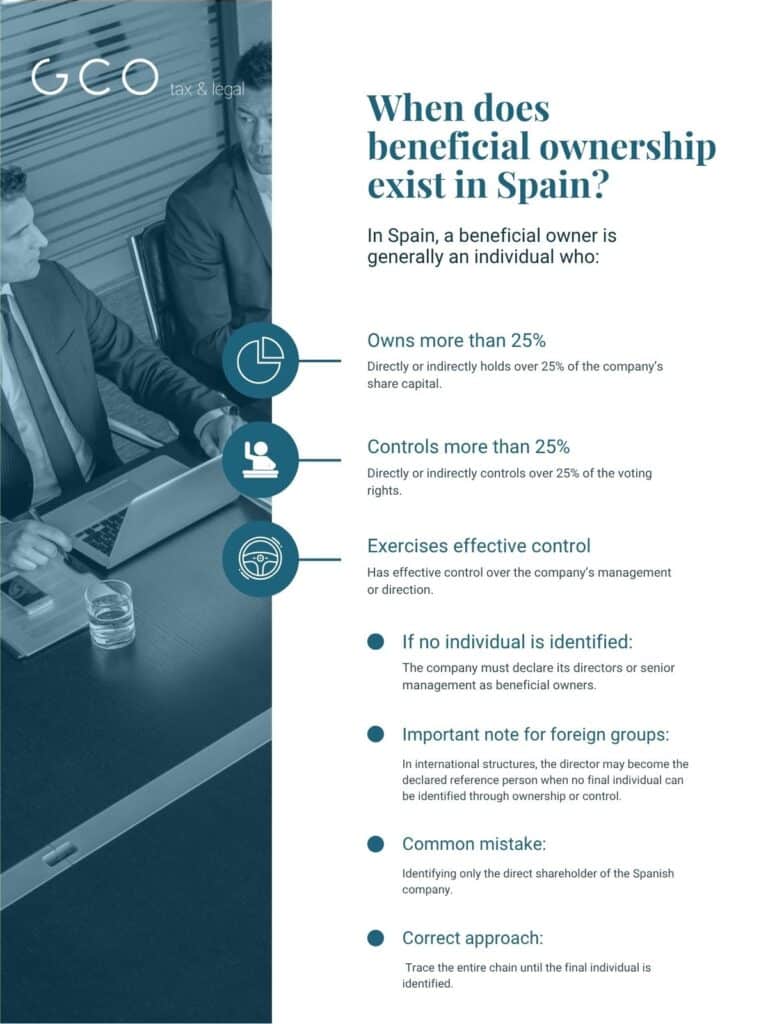
In Spain, a beneficial owner is generally considered to be someone who:
- Directly or indirectly owns more than 25% of the share capital.
- Controls more than 25% of the voting rights.
- Exercises effective control over the management or direction of the company.
If no individual can be identified under these criteria, the regulations require the company to declare its directors or senior management as beneficial owners.
This is why, in foreign groups, the role of the director becomes particularly important: the director does not only represent the company, but may also become the declared reference person when no individual can be clearly identified through ownership or control.
And this is one of the most common mistakes made by international groups: assuming that identifying the direct shareholder of the Spanish company is enough.
It is not.
The obligation requires the company to analyse the entire ownership chain until it reaches the final individual.
Why beneficial ownership is becoming a priority for international groups
A few years ago, many companies treated this obligation as a simple administrative form.
Not anymore.
Financial institutions, notaries, commercial registries and tax authorities increasingly cross-check information. Controls are also becoming stricter in international transactions.
This particularly affects:
- International holding companies.
- Groups with subsidiaries in different countries.
- Companies owned by investment funds.
- Complex family structures.
- Investment vehicles.
- Companies with indirect shareholders.
In more complex structures —such as holding companies, UTEs, AIEs or investment vehicles— the analysis should not be limited to “who owns whom”. It should also review the role each entity plays within the group, who makes the decisions, and whether any rights alter formal control.
Any inconsistency between records can lead to delays, bank account blocks or additional information requests.
And when the information is not up to date, the issue often appears at the worst possible time: during an acquisition, a capital increase, an audit or the opening of a bank account.
What international groups must disclose in Spain
The obligation to disclose beneficial ownership may arise at different times and before different authorities. That is why, before operating in Spain, it is advisable to assess whether the group’s presence should be structured through a branch or a subsidiary, as each option has different corporate and documentation implications.
In addition, beneficial ownership information is integrated into Spain’s Central Register of Beneficial Ownership, created to centralise this data. This makes it even more important for the information disclosed to be accurate, precise and up to date, as inconsistencies between sources may trigger requests for clarification and further reviews.
Commercial Registry
Spanish companies must identify their beneficial owners when filing their annual accounts and keep this information updated when relevant changes occur in the control structure.
This includes:
- Individuals with direct ownership.
- Individuals with indirect control.
- Changes in the corporate structure.
- Changes in ownership percentages.
If the structure changes and the information is not updated, the company may face registry issues and potential sanctions.
Banks and financial institutions
Spanish banks do not simply ask for the name of the beneficial owner. They usually verify the information against group charts, corporate documentation, official records and data provided by the group in other compliance processes.
They often request:
- A full group structure chart.
- The ownership chain.
- Identification of ultimate beneficial owners.
- International corporate documentation.
- Justification for complex structures.
Many transactions are put on hold because the information provided to the bank does not match the information declared before other bodies.
Corporate and notarial transactions
Company incorporations, share purchases, capital increases, mergers and other corporate changes require the correct identification of beneficial ownership.
And when foreign companies are involved in the structure, the analysis usually becomes more complex.
Especially when the structure includes:
- Trusts.
- Investment funds.
- Nominee shareholders.
- Fiduciary structures.
- Companies in multiple jurisdictions.
Mistakes banks, notaries and registries often detect
In practice, problems do not usually arise because the group does not know who controls the company. They arise because the information has not been prepared in the format required in Spain.
Not having a traceable group structure chart
The structure chart must allow the full chain to be traced: Spanish company, intermediate shareholders, parent company and final individual.
An internal diagram is not enough. It must be clear, up to date and consistent with the corporate documentation.
Declaring percentages without supporting the calculation
In groups with indirect ownership, the final percentage must be calculated step by step.
An error in that calculation can change who must be declared as the beneficial owner.
Ignoring rights that do not appear in the share capital
Beneficial ownership does not depend only on shares or equity interests.
Shareholders’ agreements, voting rights, decision-making powers, financing agreements or control over the board may also be relevant.
Not translating or legalising foreign documents
When foreign companies are involved, certificates, deeds, foreign commercial registry extracts or apostilled documents may be requested.
If these documents are not ready, a transaction may be blocked for weeks.
Reviewing beneficial ownership only when someone asks for it
The worst way to manage this obligation is to react late.
Beneficial ownership should be reviewed before opening bank accounts, signing corporate transactions, filing annual accounts, receiving investment or reorganising the group.
What are the risks of non-compliance?
The consequences go beyond an administrative fine.
Poor management of beneficial ownership can lead to:
- Bank account blocks.
- Delays in corporate transactions.
- Compliance issues.
- Information requests.
- Reputational risks.
- Issues with auditors or investors.
- Difficulties during due diligence processes.
For international groups, the impact can be even greater because it affects several jurisdictions and legal teams at the same time.
How to manage beneficial ownership correctly in international groups
In international groups, beneficial ownership should be treated as a corporate compliance process.
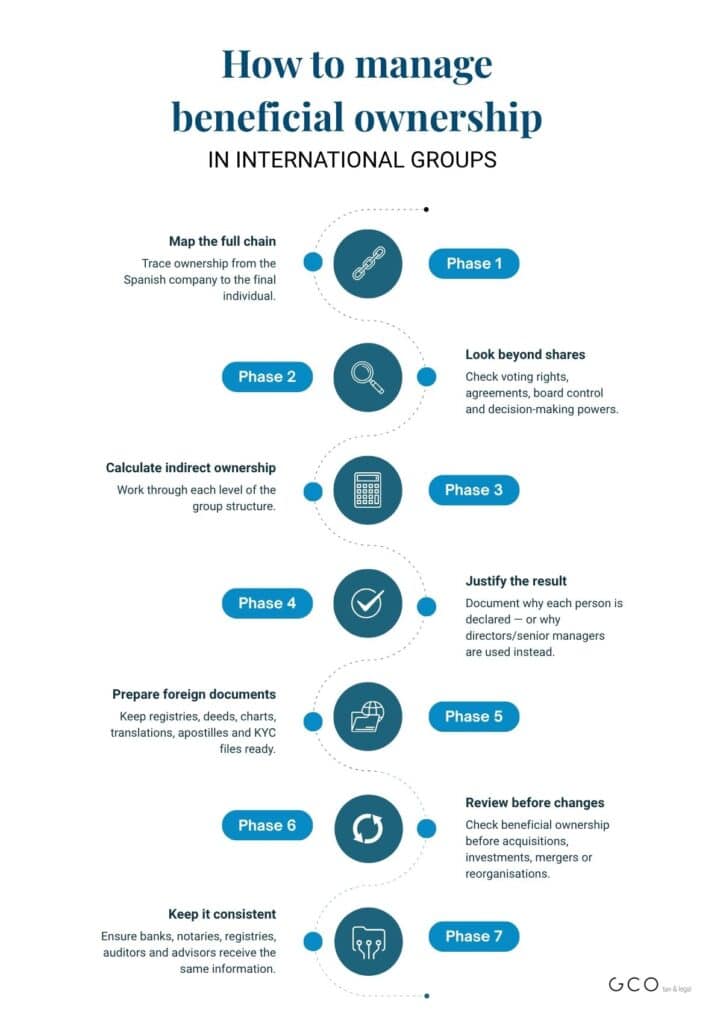
Step 1. Reconstruct the full control chain
Start with the Spanish company and work upwards until you reach the final individual.
Do not review only the direct shareholder. Analyse intermediate companies, holding companies, foreign parent companies, funds, trusts or investment vehicles.
Step 2. Distinguish ownership from control
Holding shares does not always mean exercising control.
Review voting rights, shareholders’ agreements, enhanced rights, decision-making powers and control over the board or management body.
Step 3. Calculate indirect ownership
In multi-layered structures, the ownership percentage must be calculated step by step.
This is essential to determine whether an individual exceeds the threshold that requires them to be declared as a beneficial owner.
Step 4. Justify the criterion applied
The company must be able to explain why a person has been declared as the beneficial owner.
And if no identifiable individual exists, it must justify why the board members or senior executives have been declared instead.
Step 5. Prepare foreign documentation
International groups are often asked to provide commercial registry certificates, deeds, articles of association, group charts, sworn translations, apostilles and KYC documentation.
Having these documents ready helps avoid blocks before banks, notaries or registries.
Step 6. Review beneficial ownership before relevant changes
Do not wait until the annual accounts filing or a bank request.
Review beneficial ownership before acquisitions, capital increases, investor entry, mergers, internal reorganisations or changes in voting rights.
Step 7. Maintain one single, consistent version
The information declared to banks, the Commercial Registry, notaries, auditors and advisors must match.
Any discrepancy can trigger reviews, delay transactions or raise doubts about the group structure.
FAQ: common questions about beneficial ownership in Spain
What documentation should be prepared before declaring beneficial ownership?
It is advisable to have an updated group structure chart, commercial registry certificates for intermediate companies, deeds or equivalent documents, articles of association, documentation on voting rights and, where applicable, shareholders’ agreements or documents that justify effective control.
In international structures, many documents may also need to be translated and apostilled.
Can beneficial ownership change even if the shareholders do not?
Yes. A change in voting rights, board composition, shareholder agreements or the group’s control structure can change who must be declared as the beneficial owner, even if the shareholding remains the same.
This is why limiting the analysis to share capital is often insufficient in international groups.
What happens if different countries apply different criteria for control or beneficial ownership?
This is common in multinational structures.
The problem arises when the documentation submitted in Spain does not match the information used before banks, tax authorities or registries in other countries. These inconsistencies often trigger additional reviews and information requests.
That is why it is important to coordinate the compliance approach across jurisdictions.
Who should coordinate beneficial ownership information within the group?
Ideally, there should be coordination between the group’s legal, tax, finance and corporate teams.
In international structures, the problem is rarely a single document. It is usually the lack of consistency between what the Spanish subsidiary declares, what appears at parent company level, what the bank receives and what is submitted before registries or notaries.
When are beneficial ownership issues usually detected?
They do not usually appear in day-to-day operations.
Problems tend to arise during sensitive transactions: bank account openings, investor entry, audits, due diligence processes, acquisitions, international financing or corporate reorganisations.
And the more advanced the transaction is, the greater the impact of any delay.
Can beneficial ownership affect M&A or investment transactions?
Yes. In fact, it is one of the first points reviewed by investors, funds and legal teams during due diligence.
If the corporate structure is not clear or beneficial ownership cannot be properly evidenced, the transaction may be delayed and may create legal or reputational risks for all parties involved.
Beneficial ownership as part of group control
Beneficial ownership has become a key element of transparency, compliance and corporate security.
And the more complex the international structure, the more important it is to review who effectively controls the group and how this must be declared in Spain.
Many issues do not appear when the company is incorporated. They appear later, when an audit, financing round, corporate transaction or bank review takes place.
That is why anticipating these requirements makes the difference.
Does your international group have a subsidiary in Spain?
At GCO, we help you keep its corporate, tax and documentary structure aligned with Spanish regulations and the needs of the group.
Learn more about our subsidiary management service in Spain.