

For an international company, hiring in Spain may seem like just another administrative step in the expansion plan.
In practice, every employment decision triggers a chain of implications: the applicable collective bargaining agreement, the real employment cost, the type of contract, working time records and the adaptation of global HR policies to the Spanish legal framework.
That is why labour compliance should not be addressed only when a conflict arises. It should be part of the subsidiary’s design from the outset.
The first challenge often appears when companies try to apply in Spain policies that were designed for other markets. What works in the United Kingdom, Germany, the United States or France does not always fit with the Spanish Workers’ Statute, collective bargaining agreements, the Spanish Social Security system or the criteria applied by the Labour Inspectorate.
And this is the key point: employment compliance does not have to slow down growth. When properly managed, it helps control costs, reduce risks, attract talent and make business decisions with greater confidence.
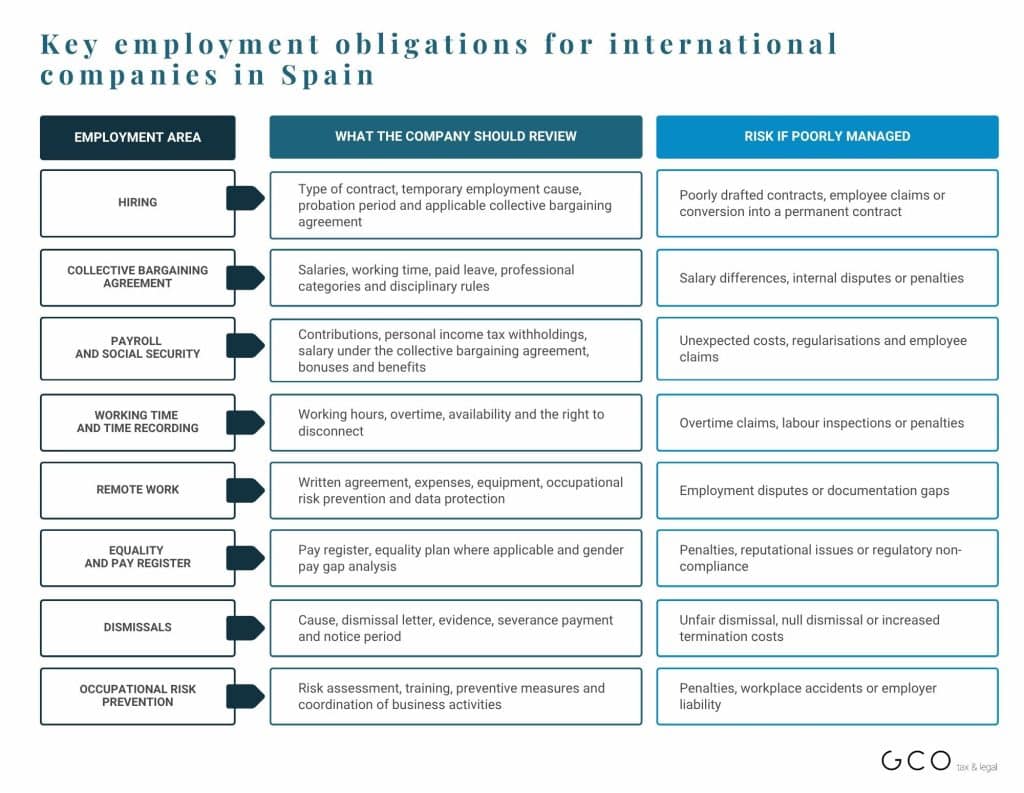
In this article, we review the key areas every international employer should understand before hiring, restructuring teams or scaling operations in Spain.
Labour compliance starts before hiring
Many companies only start thinking about labour compliance when a problem has already appeared: a labour inspection, a dispute with an employee, a salary claim or a poorly documented dismissal.
That approach comes too late.
In Spain, employment compliance begins before the first hire. The company must have a clear employer structure, identify the applicable collective bargaining agreement, set up its payroll system, register with Social Security and review the HR policies it intends to apply locally.
To hire employees in Spain, the employer must register with the Spanish Social Security system and obtain a Contribution Account Code. This identifies the company as an employer and links employees hired in a specific province to that account.
From the beginning, companies should review:
- Which collective bargaining agreement applies.
- Which professional categories correspond to each role.
- Which minimum salary under the collective bargaining agreement must be respected.
- How working time will be recorded.
- Which benefits will be treated as salary and which as non-salary items.
- Which global policies need to be adapted to Spanish employment law.
For a deeper look at this preventive approach, you can read GCO’s guide on what labour compliance is and how to implement it in a company.
Hiring in Spain: permanent contracts are the default
One important difference compared with other markets is that, in Spain, the permanent employment contract is the standard form of employment. The Spanish Workers’ Statute establishes that employment contracts are presumed to be permanent, and that fixed-term contracts may only be used for production-related circumstances or to replace another employee.
This means companies must properly justify any temporary hire.
It is not enough to say that the project is new, that the company is testing the market or that the subsidiary has only just launched. Temporary employment must respond to a real, specific and documented cause.
For an international company, this has several practical implications.
First, workforce planning should be approached with a medium-term view. If the business need is structural, a temporary contract is not the right route.
Second, contracts must reflect the reality of the role. A generic job description or a poorly defined cause for temporary employment can create exposure.
Third, probation periods must be checked against the applicable collective bargaining agreement. They cannot always be set freely.
In practice, the employment contract is not just an onboarding document. It is the first legal safeguard in the employment relationship.
Collective bargaining agreements: the factor many foreign parent companies underestimate
In Spain, the collective bargaining agreement can determine essential aspects of the employment relationship: salary, annual working time, professional classification, paid leave, salary supplements, allowances, probation periods, notice periods, disciplinary rules and compensation for overtime or additional working time.
This often surprises international groups used to applying standard internal policies across jurisdictions.
A parent company may have a global policy on bonuses, holidays, remote work or mobility. But in Spain, that policy must coexist with the Workers’ Statute and the applicable collective bargaining agreement.
That is why, before importing a global employee handbook, companies should carry out a local review.
The question is not only “which policy do we want to apply?”. The right question is: “what can we apply in Spain without creating a conflict with local law or the collective bargaining agreement?”.
Working time, time recording and flexibility
Working time is one of the areas with the greatest operational impact.
As of July 2026, the general maximum ordinary working week remains 40 hours of effective work on average over the year, unless the collective bargaining agreement or employment contract provides for a shorter working time.
The company must also guarantee a daily working time record, including the specific start and end time of each employee’s working day.
This record should not be treated as a formality. It is key evidence in overtime claims, labour inspections or disputes over out-of-hours availability.
For international companies, three areas are particularly sensitive.
Teams working across time zones.
Working with a parent company in another country can lead to calls, meetings or emails outside Spanish working hours. If this becomes standard practice, it can raise issues around working time, overtime and the right to disconnect.
Poorly documented flexibility.
Flexible working time is possible, but it must be properly organised. It does not mean permanent availability.
Senior managers and trusted employees.
Not every senior profile is exempt from working time controls. Classification must be assessed carefully.
Companies should also monitor future reforms regarding working time and digital time recording. The bill to reduce the maximum working week to 37.5 hours was rejected by the Spanish Congress in September 2025, so it is not currently in force as a general obligation.

Payroll, salary and Social Security: real employment cost goes beyond gross salary
The salary agreed with the employee is only one part of the total employment cost.
The company must take into account Social Security contributions, personal income tax withholdings, salary supplements, extra payments, benefits, allowances, bonuses and any improvements required under the applicable collective bargaining agreement.
In 2026, the Spanish minimum wage is set at €1,221 per month or €40.70 per day, depending on whether the salary is calculated monthly or daily.
However, for many roles, the relevant minimum salary will not be the statutory minimum wage, but the salary set by the collective bargaining agreement. That amount may vary depending on the sector, province, professional group and actual duties performed.
To remain competitive, a company should not simply aim to pay “the legal minimum”. It should build a remuneration policy that complies with the law, reflects the market and can withstand internal audits.
This includes reviewing:
- Base salary.
- Collective bargaining agreement supplements.
- Bonuses and variable pay.
- Benefits in kind.
- Expenses and allowances.
- Employee benefits.
- Salary increase policies.
- Consistency between actual duties and professional classification.
An incorrect payroll can create salary differences that accumulate over months or years. Those differences may later appear during a labour due diligence, an inspection or an individual claim.
Paid leave, absences and work-life balance: planning matters
Spain recognises a range of paid leave entitlements and work-life balance rights that companies must manage with precision.
The Workers’ Statute regulates paid leave, weekly rest, public holidays and justified absences. For example, paid and non-recoverable public holidays may not exceed 14 per year, two of which are local holidays. Employees are also entitled to five days of paid leave in cases such as serious accident or illness, hospitalisation or surgery without hospitalisation requiring home rest for certain relatives or cohabitants.
In addition, birth and childcare leave suspends the contract of each parent for 19 weeks, subject to specific rules on how the leave is taken and distributed.
For an international company, these rights require workforce planning. It is not enough to approve the absence. The company must plan cover, internal communication, project impact and return-to-work arrangements.
A common mistake is to treat paid leave as an administrative exception. In reality, it is part of day-to-day people management in Spain.
For a specific overview of this topic, GCO has published a guide on paid leave in Spain for international companies.
Remote and hybrid work: flexible does not mean informal
Remote work can help attract talent, reduce costs and improve productivity. But in Spain, it must be properly formalised when it meets the legal requirements for regular remote work.
Law 10/2021 establishes that expenses linked to remote work must be paid or compensated by the company and cannot be borne by the employee.
This affects hybrid teams, employees working from home several days a week and professionals who want to work from another city or country.
In these cases, companies should document:
- Remote working days.
- The place from which services are provided.
- Equipment and tools provided.
- Expense compensation.
- Occupational risk prevention.
- Data protection.
- The right to disconnect.
- Reversibility of the arrangement.
International remote work deserves a separate review. Allowing an employee to work from another country may create tax, immigration, employment and Social Security implications.

Equality, pay register and pay transparency
Equal pay has become a key area of labour compliance.
In Spain, all companies must have a pay register covering the entire workforce, including management and senior executives.
Companies with 50 or more employees are also required to prepare and implement an equality plan.
This has a direct impact on fast-growing international subsidiaries. A company that starts with 15 employees may exceed the 50-employee threshold within a short period. If it does not plan ahead, it may fall behind.
The pay register should not be treated as a spreadsheet created simply to tick a compliance box. When properly prepared, it helps detect inconsistencies, review job categories, organise salary supplements and anticipate discrimination risks.
Pay transparency will also gain importance across Europe. The EU Pay Transparency Directive requires Member States to transpose its rules by 7 June 2026, strengthening obligations around salary information, equal pay and employee access to pay data.
GCO analyses this topic in its article on what the pay register is and how it helps reduce the gender pay gap in Spain.
Occupational risk prevention: it also applies to offices, remote work and administrative roles
Occupational risk prevention is not limited to factories, warehouses or construction sites.
It also applies to offices, administrative roles, sales teams, remote work and hybrid structures.
The Spanish Occupational Risk Prevention Law requires employers to comply with preventive obligations and to develop ongoing action to improve protection standards.
This includes risk assessments, employee training, documented preventive measures, medical checks where applicable and coordination of business activities when suppliers or external personnel work at the company’s premises.
For foreign companies, the challenge is often not to underestimate this obligation in “apparently low-risk” environments.
An office can also involve ergonomic, psychosocial, digital fatigue and organisational risks.
Changes to employment conditions: change does not always mean imposing
Companies change. So do their needs.
It may become necessary to modify working hours, shifts, remuneration systems, duties, work centres or ways of providing services. In Spain, these changes may require a specific procedure if they affect substantial employment conditions.
The Workers’ Statute allows substantial changes to employment conditions when proven economic, technical, organisational or production-related reasons exist. Sensitive areas include working time, schedules, shift systems, remuneration systems, work systems and duties when they exceed certain limits.
This does not mean the company cannot adapt. It means it must do so with method.
Before implementing a change, companies should assess:
- Which condition is being changed.
- Whether it affects one employee or a group.
- Which reason justifies the measure.
- Which documentation supports the decision.
- Which notice period or consultation process applies.
- What risk of challenge exists.
Competitiveness requires flexibility. But in Spain, flexibility must be documented.

Dismissals in Spain: process matters as much as cause
Dismissal is one of the areas where international companies make the most mistakes.
In Spain, having a business reason is not enough. The reason must fit within the appropriate type of dismissal and must be communicated in the correct form.
In an objective dismissal, the company must deliver written notice setting out the cause, make the statutory severance payment available and provide 15 days’ notice.
In a disciplinary dismissal, communication must also be made in writing, stating the facts on which the dismissal is based and the effective date.
Practical problems arise when the dismissal letter is too generic, the facts are not evidenced, the collective bargaining agreement is not respected or the required steps are not followed.
For a more detailed explanation of deadlines and termination procedures, we recommend reading GCO’s article on notice of dismissal in Spain.
A poorly prepared dismissal may be declared unfair or null and void. That can lead to additional cost, loss of control over the process and internal disruption.
Labour inspections and penalties: the risk is not only financial
The Labour Inspectorate may review contracts, working time, payroll, Social Security registration, occupational risk prevention, equality, the pay register, false self-employment, interns, overtime and unlawful labour supply, among other matters.
The Spanish Law on Labour Offences and Penalties classifies employment infringements as minor, serious and very serious. In employment and labour relations, general penalties may reach €225,018 for very serious infringements, without prejudice to specific ranges for Social Security or occupational risk prevention matters.
But the risk is not limited to the fine.
There may also be:
- Regularisation of Social Security contributions.
- Salary claims.
- Surcharges.
- Loss of incentives or rebates.
- Exclusion from public aid or public procurement.
- Reputational damage.
- Impact on investment, sale or audit processes.
That is why labour compliance should be managed as part of the subsidiary’s corporate governance, not as an isolated administrative task.
How to remain competitive while complying with Spanish employment law
Compliance does not mean giving up agility.
A company can be both rigorous and competitive if it turns employment compliance into a system. This means designing clear processes, reviewing documentation and anticipating sensitive decisions.
Some practical measures include:
Create an employment compliance matrix.
Include hiring, working time, payroll, paid leave, occupational risk prevention, equality, remote work, employee representation, Social Security and dismissals.
Adapt global policies to the Spanish framework.
Do not simply translate the handbook. Localise it.
Audit contracts and payroll once a year.
Especially if the workforce grows, the applicable collective bargaining agreement changes or new benefits are introduced.
Train international managers.
Many contingencies arise from decisions made by managers who are unfamiliar with local rules.
Document sensitive decisions.
Changes in duties, underperformance, remote work, disciplinary measures, bonuses and reorganisations should all leave a clear paper trail.
Monitor workforce thresholds.
When a company exceeds certain employee numbers, new obligations arise, such as equality plans or internal reporting channels.
Coordinate employment, tax and corporate advice.
In an international subsidiary, employment decisions often have tax, corporate and financial implications.
Frequently asked questions about employment law in Spain for international employers
Can a foreign company use its global employment contracts in Spain?
They can be used as a starting point, but they must be adapted to Spanish employment law, the applicable collective bargaining agreement and Social Security obligations. A global contract without local legal adaptation can create risk.
Which type of contract should be used to hire in Spain?
The general rule is the permanent employment contract. Fixed-term contracts may only be used when there is a specific legal cause, such as production-related circumstances or replacement of another employee.
Is working time recording mandatory?
Yes. The company must guarantee a daily working time record showing the start and end time of each employee’s working day.
Do all companies need a pay register?
Yes. The pay register is mandatory for all companies, regardless of workforce size.
When is an equality plan mandatory?
Companies with 50 or more employees must prepare and implement an equality plan. It may also be required under a collective bargaining agreement or by order of the labour authority.
Can remote work be agreed freely?
It can be agreed, but it must be properly documented when it qualifies as regular remote work. The company must also pay or compensate the expenses linked to remote work.
What should a company review before dismissing an employee in Spain?
It should identify the type of dismissal, evidence the cause, review the collective bargaining agreement, prepare a solid dismissal letter and comply with all formal requirements. Process is decisive.
In summary: employment compliance in Spain is a strategic decision
Spanish employment law requires precision. Hiring, paying employees, organising working time, managing paid leave, applying remote work policies or terminating employment contracts all require proper documentation, local expertise and a clear understanding of how each decision may affect the subsidiary.
For an international company, the challenge is not just to comply. It is to build an employment structure that supports growth without accumulating hidden risks.
Before hiring, restructuring teams, integrating a company or scaling operations in Spain, it is worth reviewing whether the employment foundations are solid: contracts, payroll, collective bargaining agreement, working time records, internal policies, equality obligations, Social Security and potential contingencies.
At GCO, we support international companies operating in Spain with practical, integrated advice. We can help you identify risks before they affect the business through a labour due diligence and bring order to payroll management in Spain so that your subsidiary meets its obligations, controls costs and grows on a solid employment structure.
Complying with Spanish employment law does not have to slow down growth. When properly managed, it becomes a solid basis for making decisions, protecting the operation and competing in Spain with greater confidence.
Key takeaways
- Permanent employment contracts are the general rule in Spain.
- The collective bargaining agreement may determine salary, working time, paid leave and disciplinary rules.
- Daily working time recording is mandatory.
- Regular remote work must be properly documented and compensated.
- All companies must have a pay register.
- Companies with 50 or more employees must have an equality plan.
- Dismissals require cause, process and evidence.
- Labour compliance should be integrated into the strategic management of the subsidiary.
Employment law in Spain: how to stay compliant without slowing down your subsidiary’s growth
Spanish employment law requires precision. Hiring, paying employees, organising working time, managing leave, applying remote work policies or terminating employment contracts all require proper documentation, local expertise and a clear understanding of how each decision may affect the subsidiary.
For an international company, the challenge is to comply and to also build an employment structure that supports growth without accumulating hidden risks.
That is why, before hiring, restructuring teams, integrating a company or scaling operations in Spain, it is worth reviewing whether the employment foundations are solid: contracts, payroll, collective bargaining agreement, working time records, internal policies, equality obligations, Social Security and potential contingencies.
At GCO, we support international companies operating in Spain with practical, integrated advice. We can help you identify risks before they affect the business through a labour due diligence and bring order to payroll management in Spain, so that your subsidiary meets its obligations, controls costs and grows on a solid employment structure.